Translation Management
Verifying the accuracy of AI output
Checking the correctness of AI translation.
Quality Framework
Created:
Updated:
AI output looks good at first glance. It is hard to tell if a proofreader has done a proper job. If the proofreader skips checking some parts, it goes unnoticed.
Required is a two-layer management including “Translation (Product) Management” and “Human Management”.
Translation Management
Checking the correctness of AI translation.
Human Management
Analyzing a proofreading correction log
Confirming the rationale behind the corrections
The value of a translator has shifted. What matters now is not simply output speed, but high-level professional skills to correct AI output and the ability to manage people.
Evaluation
Pre-AI: Output speed
Post-AI: High-level professional skills and the ability to manage people (AI provides sufficient speed.)
Compensation
Pre-AI: Compensation based on output volume
Post-AI: Rating and promotion based on professional expertise and management capability
We implement a quality control framework composed of 2+1 distinct roles.
Feedback Hierarchy
Quality Manager ➡ Proofreader
Supervisory guidance on proofreading precision: Case-by-case feedback is cascaded, ensuring continuous skill advancement even for seasoned professionals.
Patent Attorney ➡ Quality Manager
High-level technical and legal advice: Advice on translation methodologies for improving translation standards.
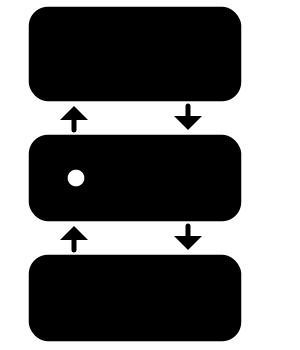
Black Arrows: Flow of Translation
Red Arrows: Flow of Feedback
Quality Managers: The Core of Our Feedback Hierarchy
Quality Managers steer each project toward success, while continuously evaluating and updating the skill levels of our proofreaders.
Only veteran translators with exceptional expertise are appointed based on the following competence:
In addition to proofreaders, Quality Managers review the translation. Quality Managers supervise the translation after proofreading.
Quality Managers supervise the translation after proofreading.
100% Supervision of Claims
All claims undergo rigorous review.
10% to 100% Supervision of Specifications
Review range depends on proofreader’s skill class.
This supervision verifies the rigor of the proofreading process. Quality Managers evaluate overall performance to determine the proofreader's skill class.
Proofreaders are classified based on skill evaluations by Quality Managers. This system allows all proofreaders to track their internal performance rating.
Associate Class (Levels 1-3): High-Precision Review
Provides high-accuracy proofreading that precisely reflects technical content of the source text.
Engineer Class (Levels 1-3): Standard-Precision Review
Expertise in patent terminology and expressions, providing standard-accuracy proofreading considering technical context.
Trainee Class (Levels 1-3): Fundamental QC
Performs basic quality control, ensuring consistency of terminology and precise document formatting.
Tiered compensation based on skill classification. Remuneration is determined by the caliber of work, not the volume processed, focusing on Quality over Quantity. This structure incentivizes proofreaders to constantly refine their expertise.
Associate Class: Remuneration Levels 7-9
Engineer Class: Remuneration Levels 4-6
Trainee Class: Remuneration Levels 1-3
We accumulate and share AI-related error cases company-wide in order to accelerate and enrich experience gain beyond the limits of individual project feedback.
We transform individual insights into collective organizational intelligence
to prevent skill silos and ensure consistent quality.
AI technology evolves at a near real-time pace. Every error case is time-stamped so that new error patterns are shared as priorities. Update alerts are automatically distributed to all members.
The freshness of knowledge directly dictates the quality of judgment and outcomes.
Our experts approach their tasks based on the latest data available.
Quality Managers serve as Group Leaders, overseeing and educating a dedicated group of proofreaders.
Long-term, consistent mentorship for group members
provides a deep understanding of each individual’s tendencies and weaknesses, and delivers consistent guidance tailored to each proofreader’s needs.